“Nobody owns the earth”
The best book I read this year was also the most personally challenging.

In 2025, my New Year’s Resolution was to post an essay on Substack once a month. While I’ve already posted one this month, I also skipped two months, and because I’m a little bit of a perfectionist, I’m posting one more to make up for it. If you’re reading this, thanks for putting up with an extra email from me.
When I worked in local politics, there were a few phrases our nonprofit organization and its associated coalition liked to repeat. One was “We still believe in the power of government to solve big problems.” Another was “We’re interested in solutions, not ideology.” Another still was “It’s okay to think this is unacceptable.” This being the disorder that has come to define the streets of most West Coast cities. We pressured local government to come up with solutions to problems like homelessness, public drug use, and onerous tax policies that inspired businesses to leave the city for laxer municipalities. Without tax revenue, we said, these problems were even less likely to be fixed. We wanted the city to be well-funded so that it could offer genuine solutions to people living on the street, particularly those suffering from addiction. It seemed obvious to most of our org that a city full of yard-sign liberals leaving people to die of drug overdoses on the street was fucked up. Street homelessness is also not that great for everyone else, like people who prefer to walk on the sidewalk instead of in traffic, or people whose kids have to walk through tent encampments and their associated needles, feces, and uncontained fires to get to school. I still believe these things. (And, full disclosure, I still do a little freelance work for local initiatives here and there, but it’s a small portion of my freelance business.)
I came to work in local politics after a year spent working with Arab-Israelis and another couple years living through the pandemic. My world view had developed to include the idea that hard problems can be solved through compromise, that under all the layers of dysfunction we have something in this country that’s worth fighting for. But the problem with politics is that in order to get a lot of different kinds of people on board with your message, you need to choose a simple way to explain your position and stick to it. I consider myself an artist and a generally skeptical person, so this made working in politics very challenging for me. But I also didn’t want those traits to keep me from ever trying to make things better. Whenever we launched a new initiative, I had to ask a lot of questions, “do my own research,” ask myself if I would be advocating for this if I wasn’t being paid to do so. More often than not, I decided I agreed with the basic tenets of our organization, even if I would have geared the advocacy toward different focus areas had I been in charge. Which I never would have wanted to be.
In January of this year, the plan for the organization changed and a lot of us were let go. I was already fairly sick of waking up each morning to Twitter mentions about how the comms plan I’d poured my heart and soul into was reading as “technofascist,” so while I was stressed out by losing my job, a part of me was also immediately relieved to be forced to move on.
Now, when people ask me if I’m following this or that horrific news story, I avoid getting into it by saying something like, “I think we are beyond politics and only art can save us.” Like my work at the political organization, this is a persona I am trying on, to see if it fits. The truth is, I have no fucking idea what can solve homelessness, loneliness, addiction, greed, war. And after only four years working in politics, I can tell you with absolute certainty that the people working in the field don’t, either. But they’re trying, which is more than most of us can say.
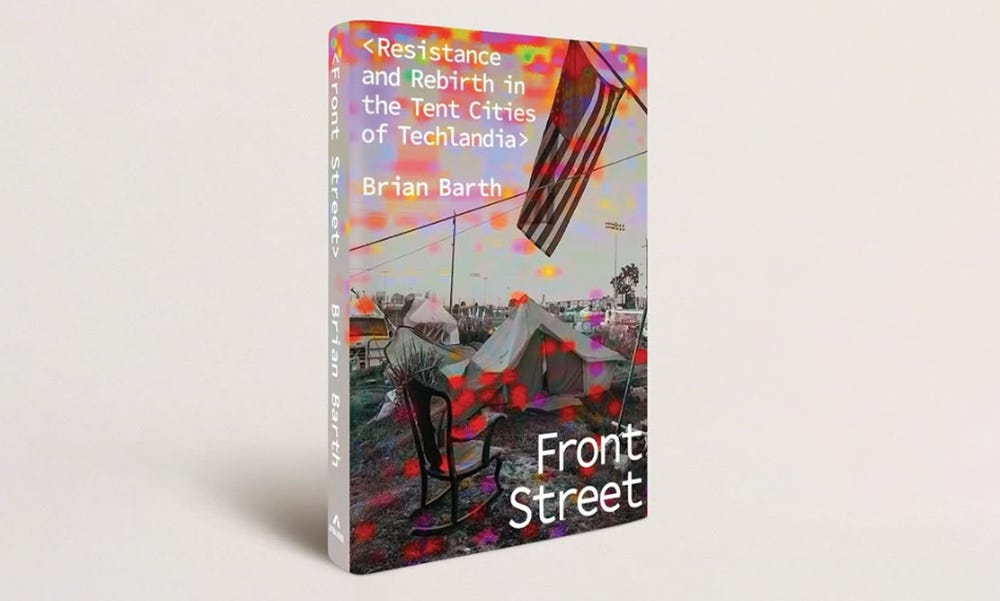
This weekend I was at the library and I checked out a book called Front Street: Resistance and Rebirth in the Tent Cities of Techlandia. This year, the same year I lost my local politics job, I also read more books than I have in years. If I had to summarize my most-updated world view, it would be: Everyone should read more books. Unfortunately, our country is headed aggressively in the other direction.
I read Front Street in two days. Journalist Brian Barth, who spent two years getting to know residents living in encampments in three Bay Area municipalities, is a stunningly beautiful writer who balances detached observation with genuine emotion so deftly that I started to feel uncomfortable. I spent two overthinky days questioning not only my political beliefs (what’s left of them, anyway), but also why the fuck I am not doing more brave things and writing about them beautifully.
Barth’s thesis, informed by his subjects, is that the tent encampments that have come to define the Bay Area are not the problem, but actually the solution. That maybe these communities are like a disowned shadow of our collective psyche and hold the key to healing what spiritually ails us. And if we just stop stepping around them in revulsion and railing against them at City Hall (and, most importantly, razing them), we’ll allow them to heal themselves. In the process those of us who are housed will learn to let in a new and powerful understanding of what it means to be human. But you can’t let that in if you don’t engage with the encampments on a human level.
I’m going to somewhat “spoil” the book, if it can be spoiled, so if you care about such things, read ahead with caution.
The other thing the book makes clear is that top-down solutions to homelessness, the kind my organization advocated for, have failed. That seems like something everyone can agree on. What will be more contentious is his assertion that letting encampments flourish or fester (depending on your view of them) in sanctioned areas is the key to healing them. What kept me reading this book so voraciously wasn’t just Barth’s razor-sharp observations and utterly perfect pacing—it was a rabid curiosity about what he proposes we DO with this information, and also a little bit of indignation. It is not until page 218 that Barth acknowledges that there are good reasons that the housed population might not trust the unhoused population, making it difficult for a social contract to be kept. Until then, he writes about the problems created by street homelessness, and the objectively bad behavior of his unhoused friends, with a bemused detachment that is both journalistically satisfying and also a little infuriating. As I read, I thought, Is he really not going to interrogate the fact that his friend Kent stole $62,000 worth of ceremonial Hindu jewelry from his neighbor, or abandoned his nine kids, or wasted a $10,000 windfall on a new electric bike when he was living in a tent? Anyone who’s ever loved someone with addiction knows that people possessed by it tend to leave a wave of spiritual, emotional, and physical destruction in their wake. It causes real hurt—just look at the tragedy that befell Ron Reiner and Michele Singer this week. That doesn’t mean that people suffering from addiction are bad people, just that perhaps the effects of their predicament might also have an impact on other people that it’s worth attempting to mitigate.
As I read, I was also kind of annoyed at Barth’s naked hatred of anyone he considers to be of the tech world: at one point, he describes downloading Hinge just so he can troll local tech workers (he ends up marrying the one person he connects with, which made me kind of doubly annoyed at him, for having dating app success at all, and for doing so and still getting to wear an anti-establishment badge). I don’t even work in tech, but a lot of my friends do, and I don’t think they’re bad people—I think they’re smart people who want to be intellectually challenged and also be able to live comfortably.
But Barth does pay this off as the book goes on by introducing us to so many concepts new to the average-but-informed normie like me that I think his contradictions are earned. He does a good job acknowledging those contradictions, and a good job explaining the political belief systems undergirding his arguments. Those systems zigzag all over the map, from his suggestion of anarchy as a paradigm for us to learn from (even if you don’t embrace it, it’s hard to argue with his explanation of why it matters), to explaining his belief in the Yoruba religion and its trickster deity, Exu.
I also saw a stunning number of parallels between his experience exploring living without a roof over one’s head and my year in the Bedouin village making a $400 monthly stipend. “The more money I’ve made,” he writes, “the more stressed about money I’ve become—a pervasive pressure to avoid losing my buying power seeps through me.” Then, a few sentences later: “Is it worth the hustle required to keep my lifestyle afloat? I’m unsure; it depends on the day and how encumbered I’m feeling by the choices I must make to maintain my comfort.” It’s a sentiment nearly everyone I know has felt on some level at some point, and his vulnerability in confronting these contradictions made me more comfortable confronting my own. Now, Barth admits, he owns several properties, one of which he makes money from on the app created by the tech barons he derides, Airbnb. But I like that he does not hide this from us. It makes me imagine that if he and I had a conversation, I could talk about my time with the common-sense-politics people and he wouldn’t judge me for it.
Barth’s ultimate recipe for change, what he calls “The Fix” throughout the book, is nuanced. It involves a return to the micro-communities that raised us, an embrace of discomfort, and an interconnectedness our culture has long abandoned. It also involves stopping encampment sweeps and sanctioning certain underutilized parts of cities to allow encampment communities to empower those who live in them to save themselves. If I could summarize it neatly, well, he wouldn’t have had to write the book. But one of the most important elements of his argument is that the housed population, being more stable, is the side that needs to take the “role of the more yielding and accommodating spouse.”
After becoming disillusioned with all “sides” of politics, I’m still skeptical of the type of politics that requires the “other side” to see its faults and change, which brings me to another of Barth’s seeming contradictions: this is actually the exact kind of attitude he says doesn’t work for the unhoused. If you can’t force someone who wants to live in a tent on the street to accept the rules of society, by the same token you cannot force someone who wants to live without the fear of a tent fire consuming their home to accept that risk. Ignoring the fact that humans all want the right to self-determination calls his entire thesis into question. He’s saying that we’re forgetting homeless people are human, but then he’s asking us to conveniently or temporarily forget that the rest of us are, too. Does that mean he thinks that people experiencing homelessness are fundamentally different from us? Is that okay?
I think he’s actually just inviting us to grow. I think he’s saying that homeless people have gone through a spiritual gauntlet that most of the rest of us haven’t, riding their misfortune right up to the edge of their very existence and surviving by the teeth of their own emotional ingenuity. People in my situation have become increasingly anxious over the past few years as the systems that used to protect us break down. But I’ve noticed that the more bad shit I experience, the more my anxiety dissipates. Okay, so your family fell apart and you lost your job and there was a pandemic and you’re single at 35 and your lifelong friend drank himself to death, and you’re still pretty much fine, I tell myself frequently. Bring on the rest of whatever’s about to happen. Barth is suggesting that letting the darkness in is the only way we can truly grapple with it.
I mentioned at the beginning that at the political org, we often railed against a lot of the dysfunction of West Coast cities as “unacceptable.” It’s a phrase that Barth quickly and efficiently dismantles as being possible to read two ways: “as harm that we bore collective responsibility to repair, or a declaration that the issue would be resolved by any means necessary. The former preserved the veneer of compassion, while the latter spoke to those concerned about excessive compassion.”
As I read, I kept returning to this word. Unacceptable. It reminded me of a lot of the conversations I have with my therapist about death. “You’re trying to explain the unexplainable,” she always says. Because that’s easier than facing the brutal fact that people die, don’t fit into society, are abused and abuse others and sometimes want to live on the street where you’d like to walk your dog. Perhaps politics, then, is trying to make unacceptable what we are actually, by virtue of being human, required to accept. Accept the darkness, accept the parts that don’t fit, accept what we are not powerful enough to change. Only then can you begin to imagine moving beyond it.
Toward the end of the book, Barth describes tramping around an encampment in the middle of the night with his friend Monte, who wanted to chant at the feet of an acacia tree beneath an overpass (naturally). When a security guard tells them to move along, Monte delivers perhaps the most thematic line in the book when he says to him, “Nobody owns the earth.” Maybe the fact that we have forgotten that, on so many levels, is the most unacceptable fact of all.
“His words didn’t quite make sense,” writes Barth. “But they kind of did.”
His words didn’t quite make sense. But they kind of did.
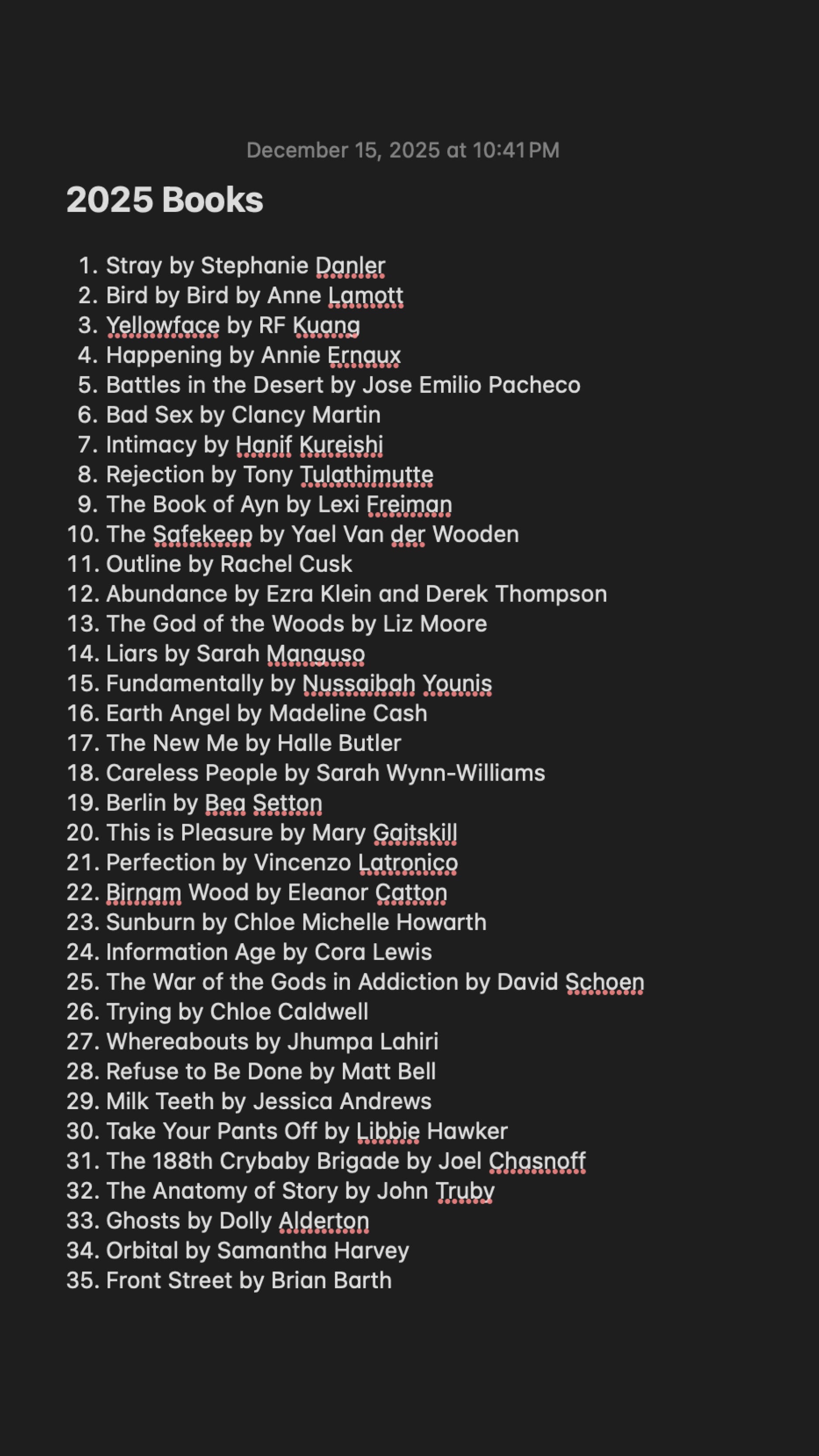
I mentioned this was my best reading year in a while. If you’re interested, here are the rest of the books I read. I’m also tearing through Paradise Logic by Sophie Kemp, and will probably read a couple more excellent books over break. Unfortunately, I usually read a lot at the end of December, when it becomes harder to brag about having done so.